
By Rory Archer
Last week, I called out of work.
That morning, I woke up slowly and silently, the glow of morning light tinting my curtains. It was an hour earlier than I needed to get up, but I stared at the wood of my bedframe, unmoving. The only thing disturbing the peace of that morning was my sniffling, and my pillow becoming increasingly wet with tears under the weight of my cheek.
I couldn’t stop. The more aware I became, the more whistling breaths turned to gasping sobs. The conscious, rational part of my brain kept looping the dream I had, my high school classmate and I visiting their partner in the hospital. Most of the dream was now fragmented and lost to my short-term memory, but my brain just kept replaying it, churning unprocessed emotions and memories until I could understand.
My friend, Z, was dead.
It had been five months since they passed, but I felt myself spiraling—the sudden awareness that I had not just been talking with them, that the dream I had was just a conglomerate of the few memories I have, that Z only exists in fallible memory, now…
I had already been crying for nearly half an hour, and at some point figured I needed to get ready for work. Moving to look at myself in the mirror, eyes red-rimmed, I could feel every breath I took rattle in my ribcage, harkening back to a familiar sternum pain I experienced nearly half a year ago.
My body lagged through my home, every tendon focused solely on keeping me upright and breathing, but my ability to keep up appearances collapsed within seconds; I stood awkwardly in the mudroom, a sting in my eyes.
“Are you alright?” my dad asked quietly, noticing me from the living room. I looked away as he approached, staring at a picture of Z I had sitting on the couch, printed out for a Día de los Muertos memorabilia box.
I let myself cry, ugly and unrelenting, as my dad drew circles on my back.
“I miss my friend,” I said.
Before
I met Z at a support group meeting for Ehlers-Danlos Syndrome in my senior year of high school, not long after I was diagnosed with the condition.
My own diagnosis story was long and tumultuous—starting with getting a severe cold two weeks into my junior year, and ending 18 months later with me, disassociating in a medication-induced obsessive-compulsive episode, in a Red Robin near the Phoenix Children’s Hospital.
Ehlers-Danlos Syndromes (EDS) are a group of 13 genetic and congenital connective tissue disorders, ranging from uncommon to rare. Patients are known for stretchy, fragile skin that bruises easily, overly-flexible and unstable joints that result in dislocation and nerve damage, and comorbidities with a variety of other developmental and autoimmune disorders.
The version of EDS I have, hypermobile type, is the most common type. It isn’t life-threatening, but its lower quality of life, alongside the various comorbidities it caused me—spontaneous allergic reactions, learning and social difficulties, speech and movement impediments, and poor oxygen regulation—was nothing to scoff at. Death was something I considered and understood through my illness; sepsis from allergens and infection was a possibility. The pain I experienced grew exhausting. Stressors pushed me to a breaking point, and I was prescribed a different antidepressant than usual. From this, I developed thanatophobia, a death anxiety, that felt like a constant, slipping ribbon of time that drew me closer to nonexistence. I was not actively dying, but my brain knew no better.
It was the first support meeting the Tucson EDS group had since COVID, held in a meeting room at the Murphy-Wilmot library. My therapist urged me to go, saying I would meet others who felt the same way, ignored by their doctors and impostors of their rare condition, misunderstood by those around them. I was one of the first to arrive, sitting awkwardly by the door, tugging at my knee brace, and laying my crutches down underneath me. I felt like a poser because I could walk without them—it just occasionally, and randomly, hurt to do so.
I admittedly remember little of the meeting, aside from the number of people interrupting each other’s conversations, hyperactive and nervous. But I remember a teenager in a wheelchair showing up a few minutes into the meeting. I moved my chair, hoping they’d sit next to me.
Their name was Z. They were six months younger than me and were diagnosed with classical EDS after fracturing their spine as a kid. They recently had a feeding tube inserted and were trying to design tape patterns for it. They loved dinosaurs.
We kept an occasional correspondence, mostly discussing health issues online when one of us posted. I felt bad for not talking with them more—I didn’t know Z outside of the unfortunate conditions that loomed over our lives, and I barely knew the other, far more complicated health issues Z had.
They would occasionally post about wanting visitors in the hospital, and I would visit. Sometimes these visits were quiet, neither of us having anything to discuss, and both of us weary; and sometimes, often with their partner, we were a bit more lively. I would bring card games and movies we’d never touch, but I was always sure to leave a gift: Z’s favorite was probably some posable suction-cup dinosaur toys my ADHD counselor offered me to pass on to them.
Each visit was to a different hospital, and none of them had the doctors Z needed, only continuing to refer Z out to other hospitals, wanting to hear from specialists who didn’t exist for Z’s condition. By the beginning of this last year, Z had lost the ability to eat entirely, dependent on total parenteral nutrition, an IV pumping nutrition into the heart. If their TPN lines failed, they would starve to death.
I remember my second-to-last time seeing them. My friend Birdie and I had trekked across town via bus and walked nearly a mile to the hospital during my spring break. I brought board games I knew none of us would touch.
There was a lot of awkward silence at first—asking “how have you been?” would’ve been a terrible question. But Z updated us on their life, how they were living with their partner now, and that Z was tired of arguing with people on medical advice, because the only person fighting for their life was Z themself. The latest hospital visit had resulted in a diagnosis of failure to thrive, a diagnosis often only given to children not growing, and elderly patients in their final months. While we joked about living it up with old people, and the benefits of their own room and having movie nights, we all remained silent about the implications of being referred to hospice.
As we chatted, a caseworker came in to tell Z that their insurance had denied coverage for TPN and began berating Z as they cried.
“What am I supposed to do? Starve?” I remember Z crying.
Birdie and I looked at each other in horror. I wasn’t sure how to respond—I felt myself fawn, scared of making what seemed like the “worst possible scenario” any worse. I was angry, but instinctively used to appeasing inconsiderate professionals who should’ve been helping me.
“I think this reaction is unreasonable,” the caseworker had said. She looked at us. “Do you think this is unreasonable?”
Z was barely 18. They were a teenager who was just told their condition was too misunderstood to warrant coverage. Z was left to die.
“I think you should come back later,” was all I could manage to say to the caseworker.
The last time I saw Z was a little more than two months later, the day before they had their colon removed. It was determined that the organ was completely nonfunctional, and needed emergency removal—and should’ve been removed long ago.
It was a quieter visit. Z asked if I would want to help them make a cake shaped like a colon after their surgery.
“Absolutely,” I said.
Sometime during my conversation with Z and their partner, loud and rowdy with gossip, Z muttered quietly, “Do you think you two could talk outside? I have a migraine.”
“Yeah, of course,” I replied. “I should probably get going, anyway. I hope tomorrow goes well.”
As I left the room, I turned to see Z drifting off, tilting their head toward the window. It was a bit of a sad view, with the window looking out onto a dirt-brown wall.
After
“I need to talk to you,” my mom said. It was late at night, and I was eating dinner alone on the couch.
“Am I in trouble?” I asked, my default response.
My mom sat down next to me, disappointment in her eyes.
“Your friend Z died yesterday.”
I stared at the ground in front of me for a few minutes.
“I’ll cry once I’ve processed it,” I said to my mom. “It doesn’t feel real yet.”
“I understand,” my mom said as she stopped rubbing my shoulder. “Come wake me, if you need.”
Two hours later, I woke my mom, eyes rimmed with tears.
“I think I’m processing it now,” I muttered into the silence of her bedroom.
Weeks passed. I checked online for obituaries, to little avail. I discovered through an Instagram post that they had passed away almost a week earlier than I thought they had. Missing it had distressed me further.
I began experiencing severe chest pain, the feeling of something pushing against my sternum from both sides, squeezing until it could crack. My lungs could never quite expand the way they needed to. I distanced myself, leaving events early as a sense of dread would purr in my ribs. When I told my doctor I felt like I couldn’t breathe, I was told to eat more bananas and talk to my therapist.
Now
As 2025 continued on, it seemed that every aspect of my life was touched by death. Four of my pets died, and one is actively dying. Two of my friend’s pets died. Z died shortly after a family friend of mine did, and two of my friends had recently lost family. Six of my friends had a family member actively dying. My roommate lost his own friend in a hit-and-run.
Everyone was dying.
I watched as my distant family moved away, as my parents grew older and sicker, and I couldn’t escape it. Everyone was a “memento mori” to my throne of young adulthood and disability—remember, you will die; everyone will die. You will grow weaker earlier than you should, and one day, everyone you depend on will die. Your childhood is over, and you will die. You will not survive this.
While I had gotten better about the existential dread of my OCD, I’d find myself checking if my pets were still breathing anytime I noticed them asleep, or checking my reflection for facial symmetry to make sure I wasn’t having a stroke. Several times a day. Just in case.
It was a vicious cycle of grief feeding into intrusive thoughts. Z died five months ago, and we weren’t close enough to have much conversation half the time I visited them, but grief welled up in me until it overflowed. I had no one to share this grief with. Z and I’s mutual friend, Quin, discussed Z when he visited town, and Birdie and I would occasionally reminisce about them. But I was too scared to text their partner now that there was this elephant in the room of our friend’s death; we couldn’t talk about anything else. I felt bad for mourning when I was so distant, as if I hadn’t earned the right to be so affected by Z’s death.
In a paradoxical way, the lack of an outlet for my grief drove me to make a memorabilia box of Z for the All Souls Procession, an incredibly large Day of the Dead celebration here in Tucson. My grief made it hard to do anything—I was falling behind in my classes, and I had no time to even create a memorabilia box. But I forced myself to at least go to the community altar dedication ceremony.
I had nothing to put up at the time, only having a bag of scrapbooking materials and some pictures, and nothing to hang them with. News crews buzzed around the ceremony, which I watched with awe and exhaustion. It was a lovely ceremony. Grief only continued burning a pit in my stomach.
I tried my best to be present in the moment, appreciating the community for such an important event, but all I could do was sit off to the side of the altar, mindlessly biting back tears as I tried to make a memorabilia box from nothing but paper and stickers.
“We can come back another time with memorabilia boxes,” my mom said.
I doubted we would. There wasn’t enough time in the world for me to do anything outside of school, let alone process my feelings. We wouldn’t be coming back in time to leave anything at the altar.
I continued school, work, and extracurriculars, making no time for grief. Grief, however, made time for me, poisoning every interaction I had with my loved ones. They are going to die, was all I could think. Everyone’s going to die.
My mother finished the memorabilia box for Z in my absence from any and all projects and responsibilities. It was a beautiful tribute, and I hated myself for not being the one to finish it.
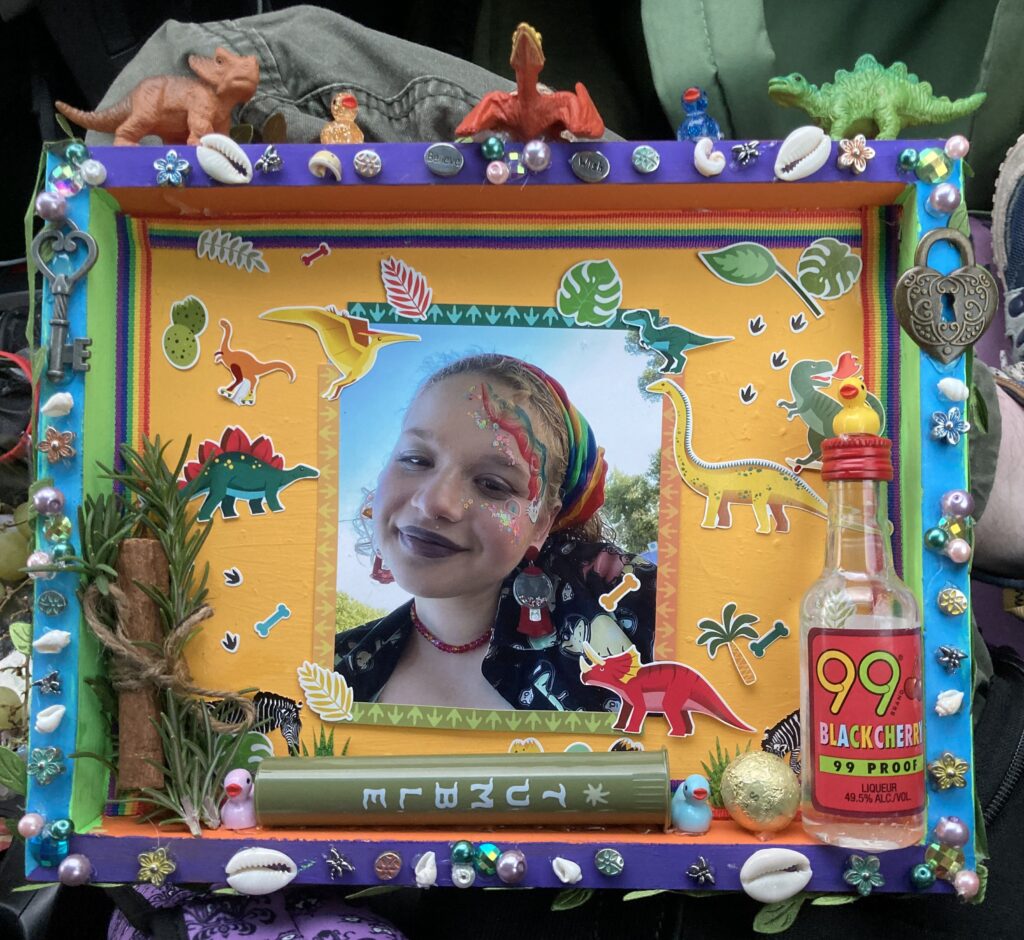
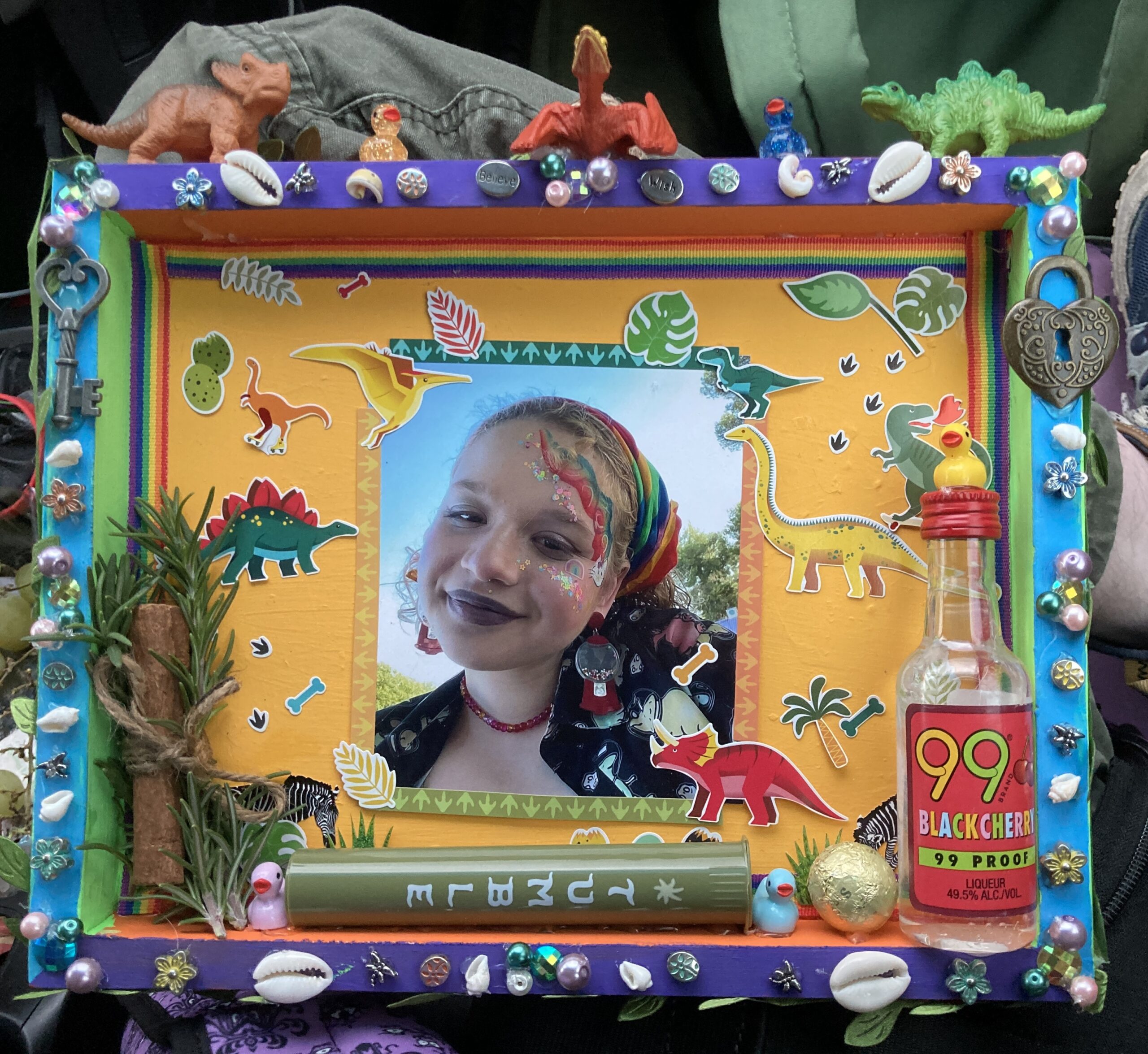
Z’s memorabilia box, featuring dinosaurs and zebras to represent their favorite animal and their rare health conditions. Photo by Rory Archer.
Day of the Dead is a celebration of grief, in spite of it. I had decided at the community altar that I had wanted to write an article on grief—if nothing else, because I knew I could never tell Z’s story in a way that could communicate everything they went through. Grief was never meant to be hidden away in someone’s chest, denied and ignored, the way I’ve been grieving. The grief hasn’t, and most likely never will, go away; I doubt the fear of death will either, as long as I reap the benefits of being alive and knowing others.
I did not know Z long enough to hear a fraction of their struggles, but I know I miss them.