
By Trigo José Marroquin

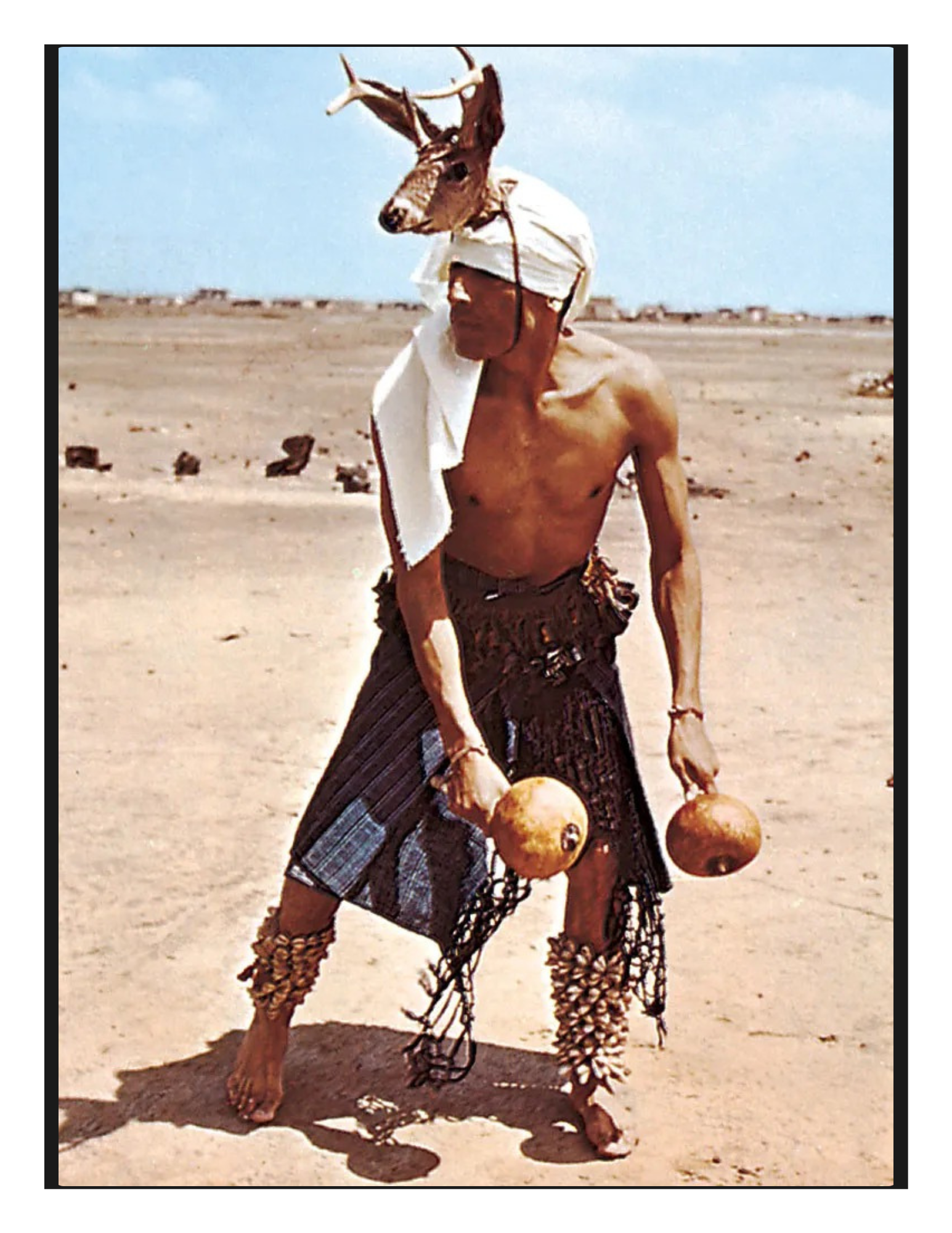
A Yaqui deer dancer. Photo by Brittanica.
As a Native person living in Tucson, Ariz., people think I know a lot about Native culture and history. But honestly, I only know the basic history, such as the Mayflower arriving and settlers killing Natives that didn’t comply with their Western ideologies. This is because I grew up outside of the Yaqui Tribe, but I think it’s time to start learning about my people’s history.
The Yaquis’ primary homelands are in the Río Yaqui Valley in the northwestern Mexican state of Sonora. Even to this day, they still live there with my family on the land. Very few still speak the original Sonoran Yaqui language, but it has evolved into the one we have today that many still know and recognize. Because of a mixture of colonization from the Spanish and British, there are two branches of the Yaqui people: one still in Sonora, and the other in Tucson.
Spain’s first attempt to invade the Yaquis was in 1553. The war lasted more than 400 years, ending in 1923, and to this day the aftermath affects almost all Yaqui people. Only about 16,000 people are able to speak the Native language. Much of the culture has mixed with French, Spanish and English influences.
While the Yaqui language depends on where you live and learn it, it differs slightly. Even though they are roughly the same, they have different forms. Think of it as U.S. English and U.K. English — the same language but with different ways of speaking. The remarks below use the orthography of the Pascua Yaqui Tribe in the United States. There are also several orthographic systems used in Mexico, differing slightly, mainly in using Spanish values for several consonants and Spanish spelling rules: “rohikte” would be written “rojicte.” There are minor differences in the sounds of Mexican and American dialects, the latter tending to exclude an intervocalic “r” and a final “k.”
In almost all cultures, religion has been a huge part of life. While the Yaqui have mixed with Christianity, many modern-day people have pushed away from Christian beliefs. Besides basic human empathy, the new generation has gone back to believing in several gods and the creator. Some follow the definition of pigeon people, ideas from before Christ — think Nordic beliefs, fairies, spirits or magic. People are starting to make ojo de venado, seen as a charm to ward off evil spirits and people. I’ve used them in the past, and they’ve worked.
While doing research, one of my classmates revealed to me that she is Yaqui herself. Her name is Paloma McKenna Priest. She said, “The Yaqui are a strong tribe where every member doesn’t need to be a follower; they are their own people.” Even today, people of the Yaqui Tribe and those with Yaqui DNA show strength in their own voice. People I’ve worked with have told me I have strength in my voice when I get into a topic. When working in a team, they’ve said my traits shine with others because I am not a follower — I am a leader. So I agree that the Yaqui are strong; we aren’t followers, and we have our own strength.