
By Rory Archer and Amira Shields

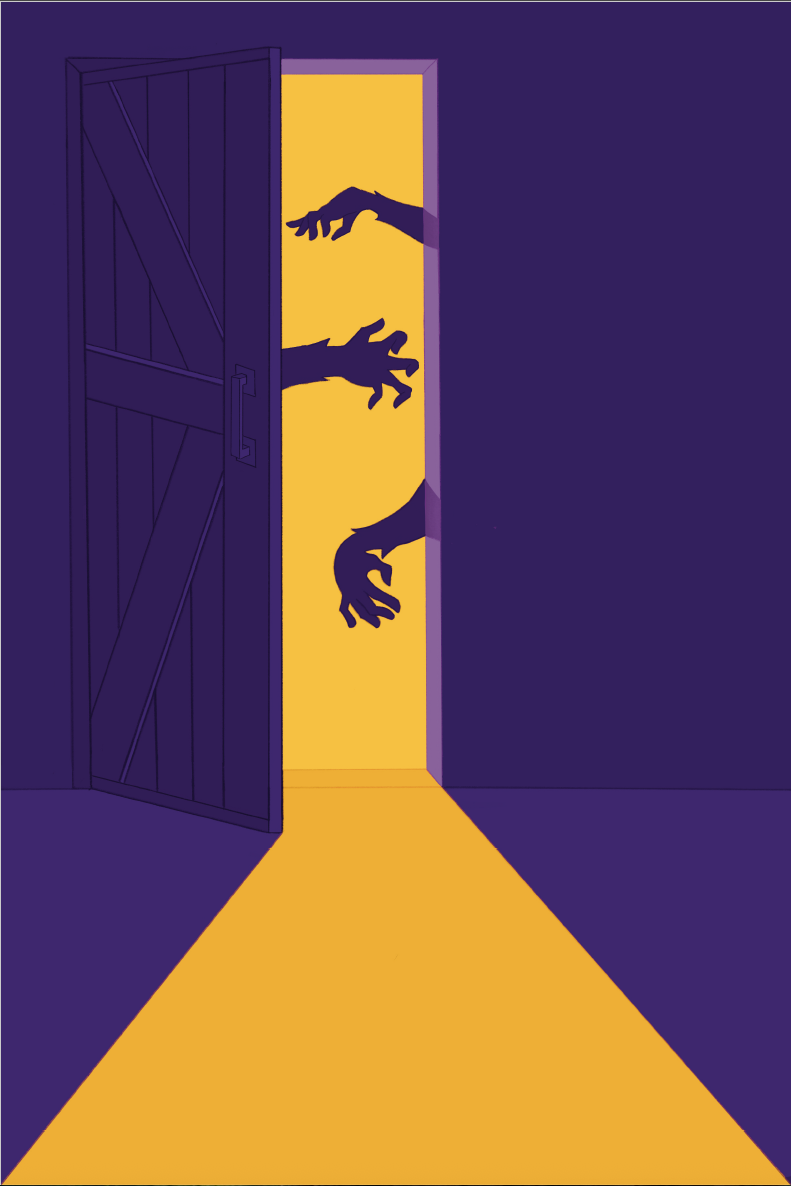
Part of PCC’s “Night of the Living Dead” poster.
TUCSON, ARIZ. — The Pima Community College Theatre program just closed its run of “Night of the Living Dead” on Oct. 26, after two weekends of showings.
The play is based on the eponymous 1968 movie, created by George A. Romero and John A. Russo, following the tensions among a group of strangers sheltering together during a zombie outbreak. The play had two casts, the Russo and Romero casts, which swapped out nightly. Nearly 30 people worked on the production.
For the play director and head of PCC’s theatre department, Chris Will, the show was an experiment in immersive set design.
“I’m just at a point in my career where I’ve been directing for 18 years now, and I don’t want to just do it ‘normal’ anymore. I feel like I’ve done that. So, let’s change things. And so, this production was—can you use film and live actors to tell one story? That was our challenge, right?”
The theatre utilized two makeshift projection boards, plywood boards banded together with strips of white fabric, with another projector pointed at the main stage, to meld recorded media with theatrical performances.
“We’ll show a picture of a zombie picking up a rock, and then you see the zombie throw it through the window on the outside, but then you see a rock come through on the inside. So it’s very interactive,” Will said. “All of the space could be a video. If there was a video showing the actor in the story, we chose not to use that. Either the space or the zombies could be projected on these screens, or we can also project on the wall.”

The title screen of the original movie is projected onto a screen next to the stage. Photo by Rory Archer.
The projections were the most challenging aspect of the project, according to both Will and performance stage manager Rebecca Hall.
“And for this production, I run the video projections that you see on the screen,” Hall said. “I’ve never [done anything like this] before. It’s been a learning curve.”
Hall continued to say that she was present for every single rehearsal for two months. The team had most video cues written and others pre-recorded during this time, but “putting it all together actually happened about a week before the show actually started running,” she said.

Zombie cast members stick their hands through the projection board’s strips of fabric. Photo by Rory Archer.
During the showings on Oct. 23 and 24, the projector system had inexplicably failed.
“The projectors ceased to work, and we had to make do with just the center projector last night. And then the day before that, we had no projections… That one was rough. Very low turnout for that one, though, so it kind of worked out,” said Caden Wilfong, who played Harry Cooper in the Romero cast of the play. “I think that actually helped everybody’s performance because we were compensating for the lack of projections.”
Despite the technical issues, the play’s technical feats paid off.
“I think that our work with the film department and how we were able to recreate some of the interviews that happened during the movie with the TV anchor, film reporters, and some characters that they were interviewing in the movie with our own actors here, was really fun,” Hall continued, when discussing the various clips projected throughout the performance. She hinted that her favorite technical aspect, however, wasn’t the projections themselves.
“You’ll notice it at the end of the show,” she said, hinting at the moving walls of the farmhouse, allowing the finale to become increasingly claustrophobic as characters felt boxed in by zombies.


The “Night of the Living Dead” program.
“When I wanted to audition for the show, it was because I heard about the moving walls from [Will], and I was like, that’s really cool. I want to be a part of the show, no matter what it is,” said Grey Hill, the actor who portrayed Harry Cooper in the Russo version of the cast.
The other Cooper, Wilfong, tacked on, “[Will] told me about splicing the movie into the show. I was like, ‘Wow, that is so awesome. I’ll be a zombie in that.’ And now I am the main antagonist.”
Hill and Wilfong worked with each other on how they’d portray Cooper in their respective casts. “I’ve definitely asked you about the intent of a few lines,” Wilfong said.
Hill continued, “Yes, because there are a few that I’ve definitely asked the same thing, done the same thing for him, because I’m just like, ‘I’m not sure. I had it this way, but I’m not sure about it. How do you feel about it?’”
“Yeah, our interpretations of the character are also just wildly different,” Wilfong said. “You have to see both shows to get both characters.”
Matthew Frankenfield, who plays Tom in the Russo cast, discussed how he approached his character.
“I fidget a lot, so I tried to play into that,” he said. “A lot of the acting is putting yourself into the characters.”

Frankenfield in zombie makeup, during a showing where the Russo cast were zombies, and the Romero cast played main characters. Photo by Rory Archer.
Another important special effect throughout the show was the use of blood, and a lot of it.
“We get plastic wrap. We put a little divot in it, we fill it with corn syrup and food dye, and then we seal it with a hair curler,” Wilfong and deck crew member Samuel Brinsley said.
“It’s a little blood capsule. I just pop it and it goes,” said Kia Benson, who plays the lead role of Bev. “I have to squeeze it a bit, though.”

Tom (Nico Alvarado) pleads to Harry Cooper (Caden Wilfong) to leave the cellar, as Bev (Kia Benson), Barbara (Charlotte Raines), and Judy (Miah Scofero) watch. Photo by Rory Archer.
The performance has been hailed as incredibly faithful to the original production.
“The biggest change is that the leading character in the movie is called Ben,” Will said. “And we decided to have our leading character be female. And so she’s Bev. But we kept Ben—So Ben’s African-American. So we thought it was really important to still have a person of color in that leading role. But [the role is] just female now. But other than that, it’s pretty close to the original, other than the mixed media thing we’re doing.”
Review
The “Night of the Living Dead” was an immersive experience that showcased the creativity of those in the Pima Arts department. The play, held in the West Campus Black Box, was a wonderful choice because it—along with the sound design by Vincent Serrano and the impressive props managed by Grimm Knoepfle—helped create a setting where the audience almost felt like part of the cast.
The cast in question was composed of so many talented actors and actresses. The performances ranged from monologues given by the main characters to zombies, who remained in character even when predominantly out of view. Each and every member of the cast, especially Charlotte Raines and Nico Alvarado, as Barbara and Tom, respectively, excel in portraying the fragility and anxiety among the survivors. The additional chemistry between Benson and Wilfong as they disagree over courses of action, Holly Fanlon’s performance as Helen Cooper as she cares for her daughter Karen (played by Stella Webb), as well as Alvarado and Miah Scofero’s presentation of Tom and Judy’s relationship, brings humanity to every character in this doomed situation.
The costumes (by Erin Anderson and Sophia Whittaker-Inserra) were beautiful, and the quick changes were executed so seamlessly that it became a blink-and-you-miss-it moment. The physical set had so many features that were fascinating to see unfold, such as the expanding/contracting main house, functioning doors, and illusion staircases. The show’s most notable feat was the use of three projections to display TV broadcasts, which worked beautifully to depict settings from the movie and show us this unfolding apocalypse through the eyes of the survivors.
The cast’s ability to compensate even in the face of technical errors, such as the projection failures during performances earlier in the week, embodies the best of PCC’s theatre program. You can tell how excited the performers are to be part of “Night of the Living Dead,” and they should be proud of the final results.

Both casts give their final bows at the end of the show. Photo by Rory Archer.